
News & Insights
External

All agrivoltaic cropping systems at a glance
An international research team reviewed agrivoltaic systems, highlighting challenges in design, crop performance, and PV efficiency, while mapping their global potential. They call for innovative layouts, targeted crop selection, and improved modeling to maximize energy yield and land-use efficiency.
External

The 5 Cs of Agrivoltaic Success Factors in the US
The U.S. Department of Energy has supported agrivoltaics research since 2015 through its Innovative Solar Practices Integrated with Rural Economies and Ecosystems (InSPIRE) research project (National Renewable Energy Laboratory 2022).
External

Why Farmers Are Shielding Their Crops With Solar Panels
Plants like sunlight, it helps them grow. So, it is understandable that many people think the more sunlight the better. Surprisingly, this is wrong. Each plant has an optimal amount of sunlight that depends on many factors, and it turns out that full sunlight is too much for many of them.
External

Agrivoltaics - Market Research and Analysis
Agrivoltaics pairs solar with agriculture, creating energy and providing space for crops, grazing, and native habitats under and between panels.
External

Agrophotovoltaics: A Double Opportunity for Latin America and the Caribbean
Agrophotovoltaic production combines crop growing and/or animal husbandry practices underneath ground-mounted solar panels. By generating renewable energy, conserving water and making an efficient use of resources, it can open the way for a low-carbon, climate change-resilient future.
External

Tracker-based agrivoltaics turn fields into wind-safe zones
Cornell University researchers demonstrated that tracking solar panels in agrivoltaic systems can protect crops from wind damage while allowing airflow, outperforming traditional single-row tree windbreaks.
External

Can Agrivoltaics Eliminate Land-Use Conflicts?
State of the Science on the Potential to Successfully and Profitably Co-Locate Solar Panels with Agricultural Production
External

Agrivoltaics increases yields, reduces water usage, and boosts rural participation in the renewable energy transition
Agrivoltaics can reduce local opposition to solar projects on farmland and create new income streams across rural stakeholder groups
Internal

Powering a Generation – Youth at the Helm
For years, the rise of renewable energy has been presented as a trade-off. To save the planet, we were told, we had to sacrifice the soil. Large-scale solar installations often replaced vital cropland, threatening food security and local economies, leading to what some call "land grabs" and the displacement of the very communities these projects were meant to serve.
External

As Federal Support for On-Farm Solar Declines, Is Community Agrivoltaics the Future?
While the Trump administration disincentivizes solar developments on farms, agrivoltaics continue anyway, with local and state support.
External
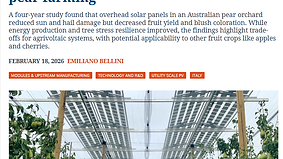
Long-term trade-offs of agrivoltaics on pear farming
A four-year study found that overhead solar panels in an Australian pear orchard reduced sun and hail damage but decreased fruit yield and blush coloration.
External

Agrivoltaics: A New Kind of Double Harvesting
Agrivoltaics is the use of land for both agriculture and solar energy generation. It attempts to solve multiple problems at once – increasing renewable energy production, increasing sustainable food production, and preserving land and water resources. There are many benefits, but also significant challenges.
External

Agrovoltaics Emerge as a Profitable Business Model for Europe and Latin America
In a context of intense global competition in the solar sector, agrovoltaics is emerging as a profitable and scalable alternative.
External

US study outlines gains and risks in agrivoltaic solar development
A new National Renewable Energy Laboratory (NREL) report says Massachusetts’ solar-on-farmland policy framework offers lessons for developers navigating both opportunity and regulatory complexity.
Internal

More Than Just Solar
For decades, we’ve been told that we have to choose between: clean energy or food; Progress or rural livelihoods; Solar farms or farmers. That framing is wrong—and it’s holding us back.